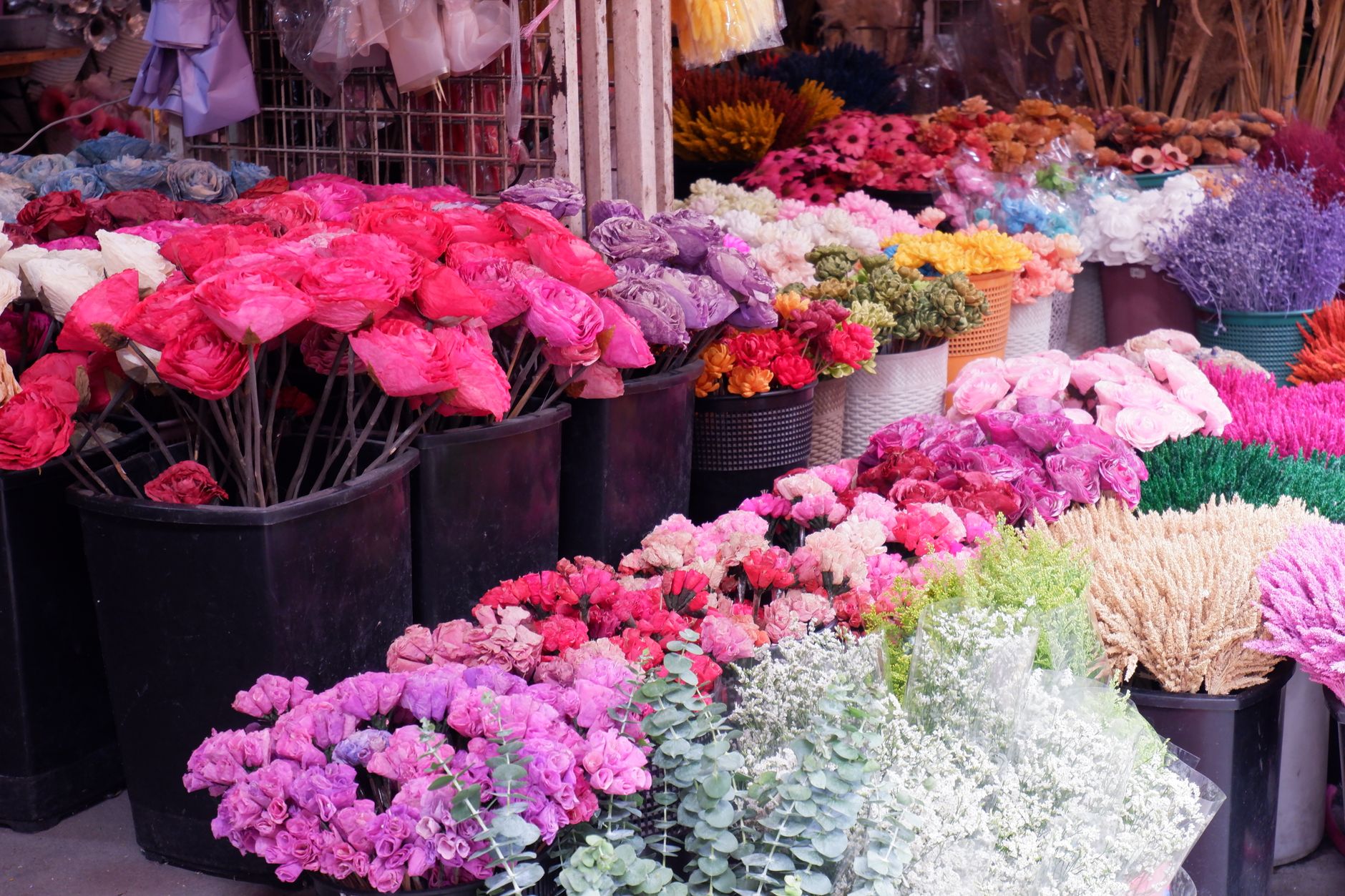
Right now — mid-June — is the most abundant flower moment of the entire year. Spring holdovers (the last sweet peas, the final garden roses of the first flush) overlap with summer arrivals (sunflowers, early dahlias, zinnias starting). The cooler is fuller this week than it will be at any other point in 2026.
But most people ordering flowers have no idea what is in season. They see a photo online from three years ago and ask for it regardless of month. Sometimes we can make it work. Sometimes we cannot. And sometimes, if they just said “what’s best right now?” — they would get something more beautiful than anything they could have picked from a website.
This is the guide. What is actually available, month by month, and why it matters.
❄️ January & February
The quiet months. Almost everything in the shop is imported — roses from Ecuador and Colombia, tulips from the Netherlands, lilies from California greenhouses. Local outdoor flowers are dormant.
- Peak: Tulips (Dutch greenhouse production peaks), anemones, ranunculus (starting late January from California), hellebores, forced paperwhites
- Available: Roses (year-round import), lilies, carnations, chrysanthemums, orchids
- Worth noting: February is Valentine’s Day — rose prices spike 2–3x due to demand. Tulips and ranunculus are the savvy alternative.
- Local: Almost nothing outdoors. Some greenhouse greens. Forced bulbs.
🌱 March & April
Spring awakens. Local production begins in warmer climates. Ranunculus hits full stride. Tulips are everywhere. The palette shifts from winter whites to pastels.
- Peak: Ranunculus (peak season — the best ranunculus you will see all year), tulips (final weeks), daffodils, hyacinths, cherry blossoms, lilac (late April)
- Available: Everything from January/February plus sweet peas (starting), stock, snapdragons, garden roses (beginning)
- Worth noting: Easter moves around (March or April) and drives lily demand. Mother’s Day prep begins in April for wholesalers.
- Local: Daffodils, flowering branches (quince, cherry, forsythia), early garden blooms depending on climate
🌸 May
The explosion. Peony season opens. Sweet peas peak. Garden roses flush. Local farms are cutting. The shop goes from “nice selection” to “overwhelming abundance” in two weeks.
- Peak: Peonies (the star — 3 week window starting mid-May), sweet peas, garden roses (first flush), lilac (finishing), lily of the valley, iris
- Available: Everything spring plus early summer stems arriving. Maximum variety of the entire year begins.
- Worth noting: Mother’s Day (second Sunday) is the busiest flower day of the year. Peony availability is limited and demand is extreme. Order early.
- Local: Peonies from local farms, sweet peas, iris, roses, foxglove, clematis, all garden perennials blooming
☀️ June
Peak abundance. This is where we are right now. The overlap month. Spring flowers finish their encore while summer flowers arrive. More variety available right now than any other time of year.
- Peak: Garden roses (still in first flush), peonies (final days — gone by mid-June), sunflowers (arriving), early dahlias (preview), sweet peas (last weeks), delphiniums, stock, snapdragons, lisianthus
- Available: Essentially everything. The only things NOT available are fall exclusives (dried elements, chrysanthemum varieties) and forced spring bulbs (tulips, hyacinths).
- Worth noting: Father’s Day (third Sunday), graduation season, and wedding season all converge. June is the second-busiest month after May.
- Local: Almost everything. Oregon, California, and Pacific Northwest farms are at full production. Sunflowers, roses, peonies (ending), sweet peas, delphiniums, foxglove, lavender — all local.
🌻 July & August
Full summer. Dahlias dominate. Sunflowers are abundant. Zinnias arrive. The palette is hot — oranges, deep pinks, bold yellows, rich purples. Arrangements feel lush, wild, and generous.
- Peak: Dahlias (the undisputed star — July through October), sunflowers (peak production), zinnias, cosmos, gladiolus, lisianthus, tuberose
- Available: Roses (year-round), lilies, all summer stems. Peonies are gone. Sweet peas are finished. Ranunculus is a memory.
- Worth noting: Heat affects vase life. Summer flowers need cool water and shade. Arrangements delivered in 95-degree weather need extra care.
- Local: Dahlias from local farms (this is Pacific Northwest dahlia country), sunflowers, zinnias, gladiolus, herbs, grasses, cosmos
🍂 September & October
The rich transition. Summer flowers finish. Fall colors emerge. Dahlias are at their absolute peak (largest heads, richest colors). The palette deepens — burgundy, rust, deep orange, amber, chocolate.
- Peak: Dahlias (dinner-plate sized in September), chrysanthemums (fall varieties), marigolds, celosia (brain-shaped and feathered), ornamental grasses, fall foliage branches, rose hips
- Available: Roses, lilies, garden roses (second flush in September), ranunculus (restarting late October from California greenhouses)
- Worth noting: Wedding season continues through October. Fall weddings get the richest palette of the year — jewel tones that June cannot match.
- Local: Dahlias (final glory), chrysanthemums, dried grasses, fall foliage (maple, oak, beech branches), rose hips, bittersweet
🍁 November & December
Holiday and winter. Local production winds down. Imports dominate again. The palette is evergreen, red, white, and metallic. Holiday arrangements lean heavily on texture — berries, pine, cedar, eucalyptus.
- Peak: Amaryllis (the holiday star), paperwhites, evergreen arrangements (cedar, pine, fir, holly), poinsettias, red roses, winterberry (ilex)
- Available: Roses, lilies, orchids, carnations, chrysanthemums (all year-round imports). Ranunculus and anemones starting again late December.
- Worth noting: Thanksgiving and Christmas/Hanukkah drive massive demand. Poinsettia season is November through December only. Amaryllis is a 6-week window (late November through January).
- Local: Evergreen boughs, holly, winterberry, dried elements. Almost no fresh-cut local flowers until spring.
💰 Why Seasonal Matters (The Practical Reasons)
- Freshness: Seasonal flowers have shorter supply chains. A local June peony was cut yesterday. An imported off-season peony flew 5,000 miles from Chile. Which one lasts longer in your vase?
- Cost: When supply is high, prices drop. Sunflowers in July cost half what they cost in January (if you can even get them). Ordering in-season saves money without sacrificing quality.
- Vase life: Fresh, seasonal stems last significantly longer than out-of-season imports because they spent less time in cold storage and transit.
- Beauty: Flowers at peak season are at peak quality. The colors are richer, the heads are larger, the fragrance is stronger. A May peony looks nothing like a November peony import — the May one wins every time.
- Environmental impact: Local, seasonal flowers do not require transcontinental air freight. Shorter distances mean smaller carbon footprints.
🎯 The Always-Available List
These flowers are available year-round thanks to global production (mostly Ecuador, Colombia, Netherlands, and California greenhouses):
- Roses (all colors, all sizes, all year)
- Lilies (Asiatic, Oriental, LA hybrids)
- Carnations and spray carnations
- Chrysanthemums (standard and disbud)
- Orchids (phalaenopsis, dendrobium, cymbidium)
- Alstroemeria
- Eucalyptus and common greenery
These are always an option. But “always available” also means “never at a peak.” They are reliable, not remarkable. The remarkable flowers are the seasonal ones.
⭐ The Worth-Waiting-For List
These flowers have strict seasons and cannot be forced or faked year-round:
- Peonies: May–early June only. 3 week window. Worth every moment of waiting.
- Dahlias: July–October. The summer and fall star. Hundreds of varieties.
- Sweet peas: April–June. Fragrant, ruffled, and gone by summer heat.
- Ranunculus: January–May (California). Paper-thin petals in tight rosettes.
- Lilac: April–May. 2–3 week window. Intensely fragrant.
- Lily of the valley: May only. Tiny bells, massive fragrance, brief appearance.
- Amaryllis: November–January. The dramatic holiday bloom.
💬 How to Order Seasonally
The single best thing you can say to a florist: “Use whatever is best right now.”
That one sentence gives us permission to build you the most beautiful arrangement possible using peak-season stems at their freshest. No hunting for out-of-season flowers. No substitutions for something that is not available. Just: the best of what today offers, designed by someone who knows what is singing this week.
This is what Designer’s Choice actually means. And it is almost always the best arrangement in the shop — because the florist is working with what is freshest, most abundant, and most inspiring at that exact moment.
Browse our arrangements — right now in June, that means garden roses, sunflowers, delphiniums, lisianthus, and the full abundance of early summer. Tell us your budget and let us choose. You will not be disappointed. For the full story of how imported flowers travel to reach your table, read about the 72-hour global supply chain. And for the meaning behind any flower you choose, see our honest guide to flower symbolism.