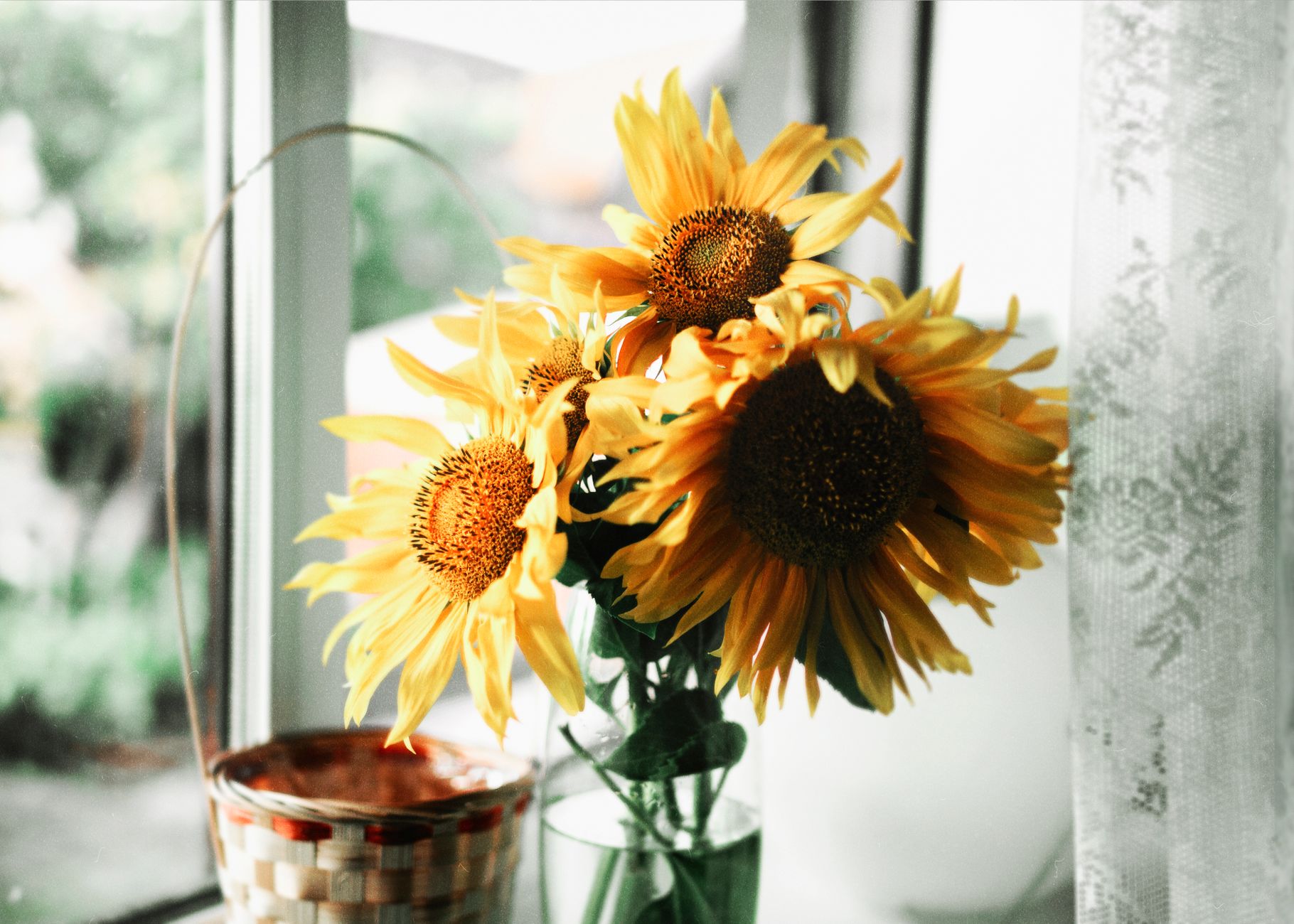
There is one flower that does not need an introduction, a symbolism lesson, or a hard sell. You hand someone a sunflower and their whole face changes. It is the flower of roadside farm stands and kids’ drawings and the exact middle of summer — big, bold, unbothered, and impossible to be in a bad mood around. And right now, in the long bright stretch of mid-to-late July, the sunflower is at the peak of its powers.
But the sunflower is also a much more interesting flower than its cheerful reputation suggests. There is real botany behind that giant face, a florist revolution hiding in the word “pollenless,” and a famous myth that is only half true. Here is everything you need to know about sunflowers — where they come from, the varieties worth knowing, how to make them last, and why they belong on your table all summer long.
🌻 What Exactly Is a Sunflower?
Sunflowers (Helianthus annuus) are native to North America, where Indigenous peoples cultivated them for thousands of years for their seeds, oil, and dye long before they became an ornamental icon. Spanish explorers carried them to Europe in the 1500s, and they eventually traveled the world — famously becoming a national symbol in Ukraine and the subject of Van Gogh’s most beloved paintings.
Here is the fact that surprises people most: that big “flower” is not one flower at all. It is a composite — hundreds or even thousands of tiny individual flowers packed together. The outer ring of “petals” are ray florets, and the whole central disc is made of hundreds of little disc florets, each one capable of becoming a seed. When you look at a sunflower, you are really looking at an entire bouquet disguised as a single bloom.
🌀 The Fibonacci Thing (Yes, It’s Real)
Look closely at the center of a sunflower and you will see the seeds arranged in interlocking spirals — one set curving clockwise, another counterclockwise. The number of spirals almost always lands on consecutive Fibonacci numbers (34 and 55, or 55 and 89). It is not magic; it is the most efficient way to pack the maximum number of seeds into a fixed space without gaps. But it is one of the most genuinely beautiful examples of math showing up in nature, and it is sitting right there in a flower you can buy for a few dollars.
🌞 Do They Really Follow the Sun?
This is the question everyone asks, and the honest answer is: yes, but only when they’re young. The sun-following behavior is called heliotropism, and it happens in the bud-and-growth stage: young sunflower plants track the sun east to west across the sky during the day, then swing back east overnight to be ready for dawn. It is driven by differences in growth on each side of the stem.
But here is the part the postcards leave out: once a sunflower matures and the flower fully opens, it stops tracking and settles in place — almost always facing east. Scientists believe the morning warmth on an east-facing bloom helps attract more pollinators. So the romantic image of a field of open sunflowers all swiveling to follow the sun is a myth. A field of open sunflowers is a field all facing the same direction: toward the sunrise. Which is arguably even better.
🎯 The Varieties: Way More Than One Yellow Flower
“Sunflower” covers a lot more ground than the single giant on a thick stalk. A few types worth knowing:
- Single-stem giants. The classic — one enormous head on one tall stalk, the ones that tower over the garden. Dramatic and unmistakable.
- Branching varieties. These produce many smaller blooms on side stems over a long season — the cut-flower grower’s favorite, because one plant keeps giving.
- Pollenless hybrids. Bred specifically to shed little or no pollen (more on why that matters below). The florist industry standard.
- Colored and novelty types. Beyond classic gold, sunflowers now come in rich mahogany, burnt orange, soft lemon, and even dusky red — plus “teddy bear” types that are fluffy, double, and almost pom-like.
That range means a sunflower can be the bold single statement in a jar or a warm supporting player woven through a bigger summer arrangement — a lot like the way we use other cut-and-come-again summer stars such as zinnias.
🧹 Why Pollenless Sunflowers Changed the Game
If you have ever set a classic sunflower on a table and come back to a dusting of yellow-brown pollen everywhere — the tablecloth, the counter, your hands — you have met the reason florists love pollenless varieties. Traditional sunflowers drop a lot of pollen, which stains fabric, shortens the arrangement’s tidy life, and is no friend to allergy sufferers.
Pollenless hybrids solve all of that. They keep the exact same look with clean centers that do not shed, they last noticeably longer as cut flowers because the bloom is not spending energy on pollen, and they are far kinder to sensitive noses. When your florist hands you sunflowers, they are almost certainly the pollenless kind — it is one of the quiet upgrades that made this flower a year-round cooler staple instead of a garden-only novelty.
⏳ How to Make Them Last
Good news: sunflowers are tough. With a little care they will reliably give you a solid week or more — longer than many showier flowers. The habits that matter:
- Give them plenty of clean water. Sunflowers are thirsty and their thick, fuzzy stems drink hard. Keep the vase topped up and change the water every couple of days — the core of all our fresh-cut care tips.
- Re-cut the stems and strip low leaves. A fresh angled cut and no foliage below the waterline keeps the water clean and the stem drinking freely.
- Use a sturdy vase. That big head is heavy — a narrow or top-heavy vase will tip. A wide, stable base keeps them upright.
- Keep them out of direct heat and sun indoors. Ironically, the cut flower does not want a hot windowsill — that’s one of the classic mistakes people make with flowers in summer.
🌅 When Is Sunflower Season?
Right now. Sunflowers are the signature bloom of high summer — they hit their stride in July, run strong through August, and carry into September, overlapping beautifully with the late-summer dahlia season. Both Oregon and California grow gorgeous sunflowers, and mid-to-late July is when the local, field-grown ones are at their absolute best. This is exactly the flower you see front and center in what’s in season right now — and buying it in season means the freshest, longest-lasting, best-value blooms of the year.
💛 Why Everyone Loves Them
There is no flower that delivers more pure, uncomplicated joy per stem than a sunflower. It does not need an occasion. It does not carry heavy symbolism or fussy rules. It just shows up big and golden and generous, turns a plain jar on the kitchen counter into a shot of summer, and makes whoever receives it grin like a kid. That is the whole appeal, and it is more than enough.
So while the fields are full and the local crop is at its peak, this is the moment. Come see what is in the cooler — and let us build you an armful of the happiest flower there is, delivered while summer is wide open.