
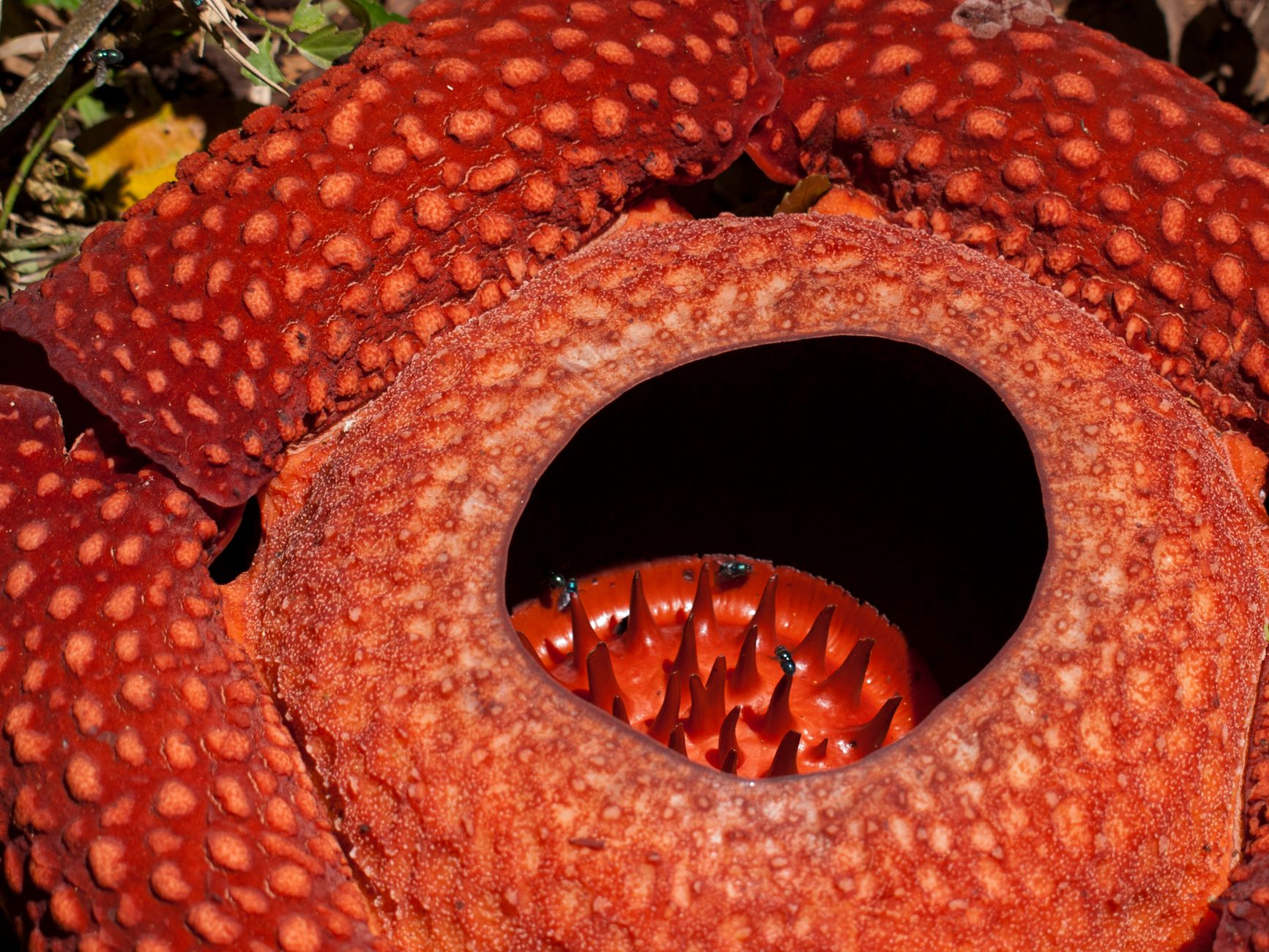
Most of what we do at sancarlosflorist.com involves flowers that are, by design, extremely pleasant — good smells, soft colors, the kind of thing you would happily put in the middle of a dinner table. Today we are setting all of that aside. Here is our tour of the flower world's absolute weirdos: the ones that stink, the ones that mimic animals, and the ones that would happily eat the insect they just tricked into visiting.
💀 The One That Smells Like Death, On Purpose
The titan arum (Amorphophallus titanum), better known as the corpse flower, produces one of the largest unbranched flower clusters on the planet — and when it finally blooms, after a bulb can spend years quietly building up energy for the event, it releases a smell deliberately engineered to resemble rotting flesh. This is not an accident or a side effect. The stench, combined with a reddish-purple color and actual heat the plant generates to help the odor carry further, is a precision tool for attracting the carrion flies and beetles that pollinate it in its native Sumatran rainforest.
Because it blooms so rarely and only stays open for a day or two when it does, a titan arum flowering at a botanical garden anywhere in the world tends to become a genuine event — visitors lining up, and in the age of the internet, tens of thousands of people watching a livestream of a plant that smells terrible, just to see it happen. It might be the single best example of a flower optimizing for something other than beauty, and doing it extremely well. If you want more on how flowers behave once the lights go down — the ordinary, pleasant kind included — we covered the science in what your flowers do when the sun goes down.
🐒 The Orchids That Impersonate Animals
Orchids are, as a family, the plant kingdom's most committed method actors, and a few of them commit so hard the results are genuinely startling:
- The monkey-face orchid (Dracula simia), native to the cloud forests of Ecuador and Peru, has a bloom that looks disarmingly like a small monkey's face staring back at you — complete with what appear to be eyes, a nose, and a mouth. The genus name Dracula refers to the two long, fang-like spurs on the flower, not anything more dramatic.
- The naked man orchid (Orchis italica), found around the Mediterranean, produces dozens of tiny florets that each resemble a little human figure, arms and legs included — enough that the whole flower spike looks like a crowd of miniature people.
- The bee orchid (Ophrys apifera) does not just look like a bee for our benefit — it is an elaborate act of fraud aimed specifically at male bees. The flower mimics the appearance and even the pheromone scent of a female bee closely enough that males attempt to mate with it, and in the process, unknowingly pollinate the plant. The orchid gets pollinated; the bee gets nothing. It is one of the most specific deceptions in all of nature, evolved purely to exploit one insect's instincts.
None of this is decoration. Every one of these resemblances evolved because it improved the flower's odds of getting pollinated by a very specific, very foolable audience.
🦋 The Ones That Eat Their Visitors
Most flowers have a deal with their pollinators: come for the nectar, leave with some pollen, everybody wins. Carnivorous plants scrapped that arrangement entirely. The Venus flytrap snaps shut on prey using trigger hairs sensitive enough to detect an insect's touch, closing fast enough to catch it before it can escape. Pitcher plants take the lazier but equally effective route, growing modified leaves shaped like deep, slippery-walled cups that fill with digestive fluid — an insect wanders in chasing nectar and simply cannot climb back out. These are not flowers behaving badly toward their pollinators; carnivorous plants generally digest insects for nutrients using entirely different parts of the plant than the ones responsible for actual pollination, but the sheer menace of the strategy earns them a spot on any weird-flower list regardless.
🔥 The One That Makes Its Own Heat
Skunk cabbage, a swampy early-spring bloomer, pulls off a trick that sounds more like an animal ability than a plant one: it generates its own heat through a process called thermogenesis, warming itself enough to melt through late snow and push its foul-smelling bloom up ahead of almost anything else in the forest. The heat also helps volatilize its odor, carrying the smell further to attract the flies it depends on — the same basic strategy as the corpse flower, on a much smaller and considerably colder scale.
🌸 Back to Our Regularly Scheduled Beauty
If all of this has you newly grateful for a flower that simply looks nice and smells like a flower, we do not blame you — and we would point you toward our rainbow flower guide as the perfect palate cleanser. If instead this has sparked a genuine curiosity about growing something stranger than a rosebush, the nurseries and garden centers near San Carlos are a good place to start asking questions. And if you would rather admire the classically beautiful end of the botanical spectrum instead, our piece on Filoli's cutting gardens is about as far from a corpse flower as the plant kingdom gets.
Pollination biology, it turns out, does not care about being pretty. It cares about what works — and evolution has produced some genuinely bizarre answers to the same basic problem every flower has to solve. We happen to think that makes the ordinary, lovely stuff on your table just a little more remarkable by comparison.