
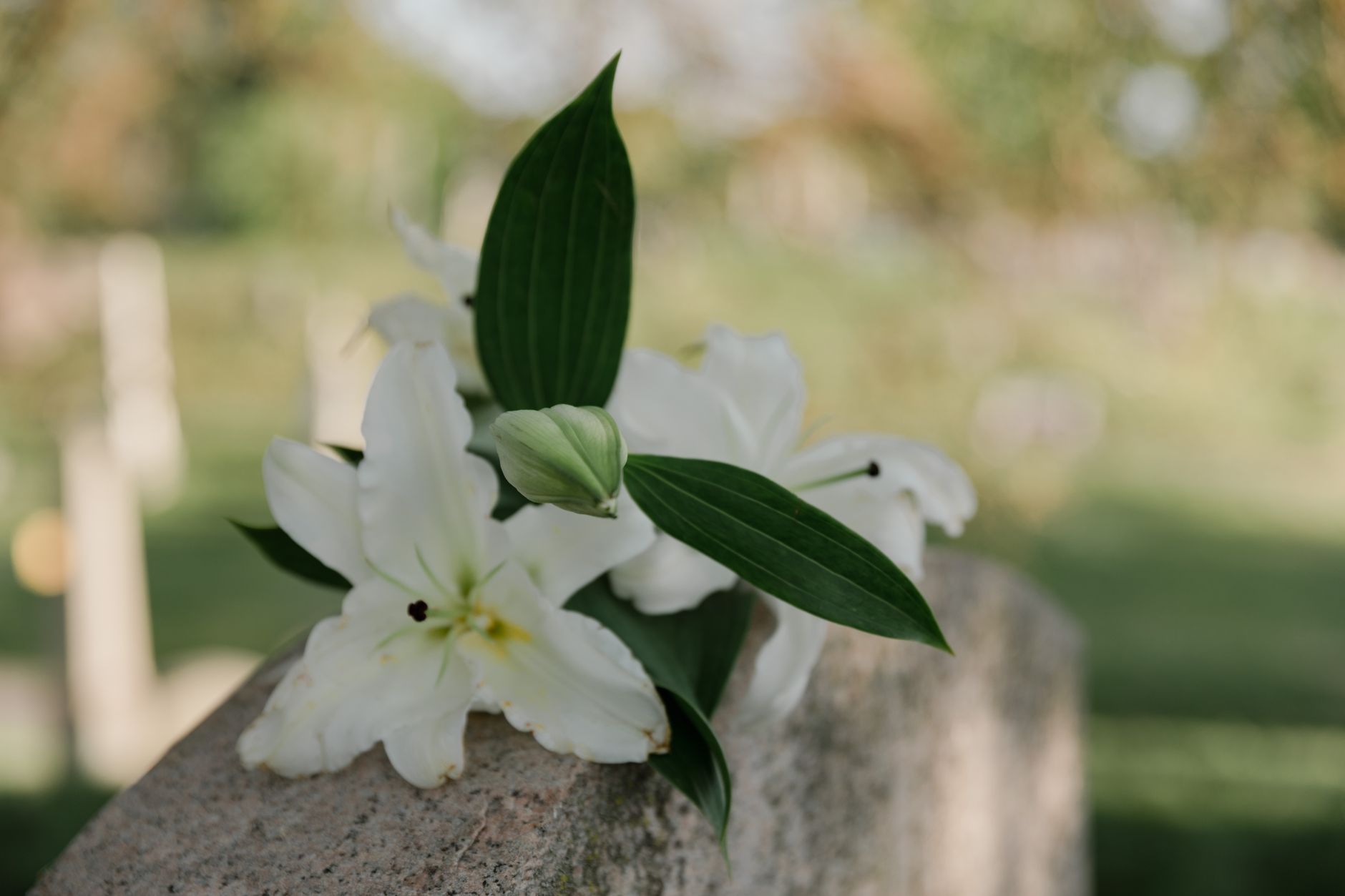
Every arrangement that leaves our shop for a funeral home, a memorial service, or a grieving family's front porch is part of a pattern that is almost certainly older than agriculture, older than writing, and older than most of what we consider civilization. We do not usually stop to think about that while we are wrapping stems. But it is worth pausing on, because the honest answer to “why do we send flowers when someone dies” turns out to be more interesting, and more moving, than most people realize.
🧬 The Famous Story That Turned Out to Be Wrong
For decades, the go-to answer to “how far back does this go” was a single, celebrated piece of archaeology: the Shanidar Cave burial site in Iraq, where researchers in the 1960s found clusters of ancient pollen alongside a 60,000-year-old Neanderthal skeleton. The conclusion, repeated in textbooks for two generations, was that Neanderthals had gathered wildflowers and laid them across their dead — proof that even our evolutionary cousins understood loss well enough to mark it with something beautiful.
In 2023, a team from the University of Cambridge and Liverpool John Moores University went back through that evidence with modern tools, and the story did not hold up. The pollen clusters turned out to be far more consistent with ancient solitary bee burrows in the cave sediment than with deliberately placed flowers, and the specific plant species identified do not even bloom at the same time of year — meaning nobody could have gathered them all in a single visit. The bees, not the Neanderthals, were the likely source. It is a good reminder that even our most cherished stories about the past deserve to be checked, and that being wrong about the details does not mean the underlying instinct is not real. The evidence for Neanderthal burial itself, deliberately arranging a body with care, still stands. It just probably was not decorated with flowers.
🏺 Where the Real Evidence Actually Begins
Once you set that particular story aside, the honest, well-documented history of flowers and mourning still runs remarkably deep. Ancient Egyptian tombs are full of it: when Howard Carter opened Tutankhamun's tomb in 1922, he found a floral collar draped across the young pharaoh's coffin, woven from olive leaves, cornflowers, and blue lotus petals, still faintly holding their color after more than 3,000 years sealed in the dark. Egyptian funerary texts describe flowers as offerings meant to accompany the dead into the next life — not decoration, but provisions for the journey.
The custom shows up again and again across civilizations that had no contact with one another: garlands in Greek and Roman burial rites, floral offerings in early Chinese funerary practice, marigolds threaded through ofrendas in Mesoamerican tradition long before they became part of Día de los Muertos. Different flowers, different meanings, different rituals entirely — but the same basic instinct, showing up independently again and again, everywhere humans have buried their dead with any ceremony at all.
🖤 The Victorians Turned It Into a Whole Language
By the 19th century, in both Britain and the United States, mourning had developed an entire vocabulary of its own, and flowers were fluent in it. White flowers signaled purity and the innocence of a life cut short. Ivy, woven into wreaths, stood for immortality and undying memory. Rosemary meant remembrance in the most literal sense — it is where the phrase comes from. Cemeteries of the era were landscaped as gardens on purpose, meant to be walked through, not just visited on the day of burial, because grief was understood as something ongoing, not a single afternoon to get through and move past.
Some of that formal language has faded. The instinct behind it has not. We still reach for white when we are not sure what else to choose, and most people can tell you that a wreath means something different from a spray without ever having studied why.
🧠 What the Gesture Is Actually Doing
Grief researchers who study mourning rituals across cultures keep landing on a similar explanation for why this custom has survived everywhere, for this long: flowers give people something to do when there is genuinely nothing to be done. Death does not come with a task list. It comes with helplessness, and helplessness is one of the hardest feelings for a human being to sit inside. Choosing an arrangement, writing a card, arranging for a delivery — these are small, concrete actions in the middle of something that offers no other action to take.
There is also something quietly honest in a cut flower's own mortality. It will not last. Neither did the life being mourned. A bouquet that fades over a week is not a flaw in the gesture — it may be the most truthful part of it, a small, temporary, beautiful thing offered in the face of a loss that is permanent.
🌸 What We Have Learned Doing This Work
We wrote a longer, more practical guide to sending sympathy flowers on the Peninsula — the funeral homes, the etiquette, what to write when the words will not come. That piece is about the logistics. This one is about the deeper why, and after enough years doing this work, we have come to believe the two are not really separate questions. People do not send flowers because tradition says to. They send them because some instinct, running back through the Victorians, through ancient Egypt, through every culture that has ever buried a loved one with intention, recognizes that presence matters more than perfect words, and that showing up with something living, even something temporary, says what silence alone cannot.
If you are standing at the edge of someone else's loss right now, unsure what to do, that instinct is worth trusting. It has been carrying people through exactly this moment for longer than almost anything else we still do.