
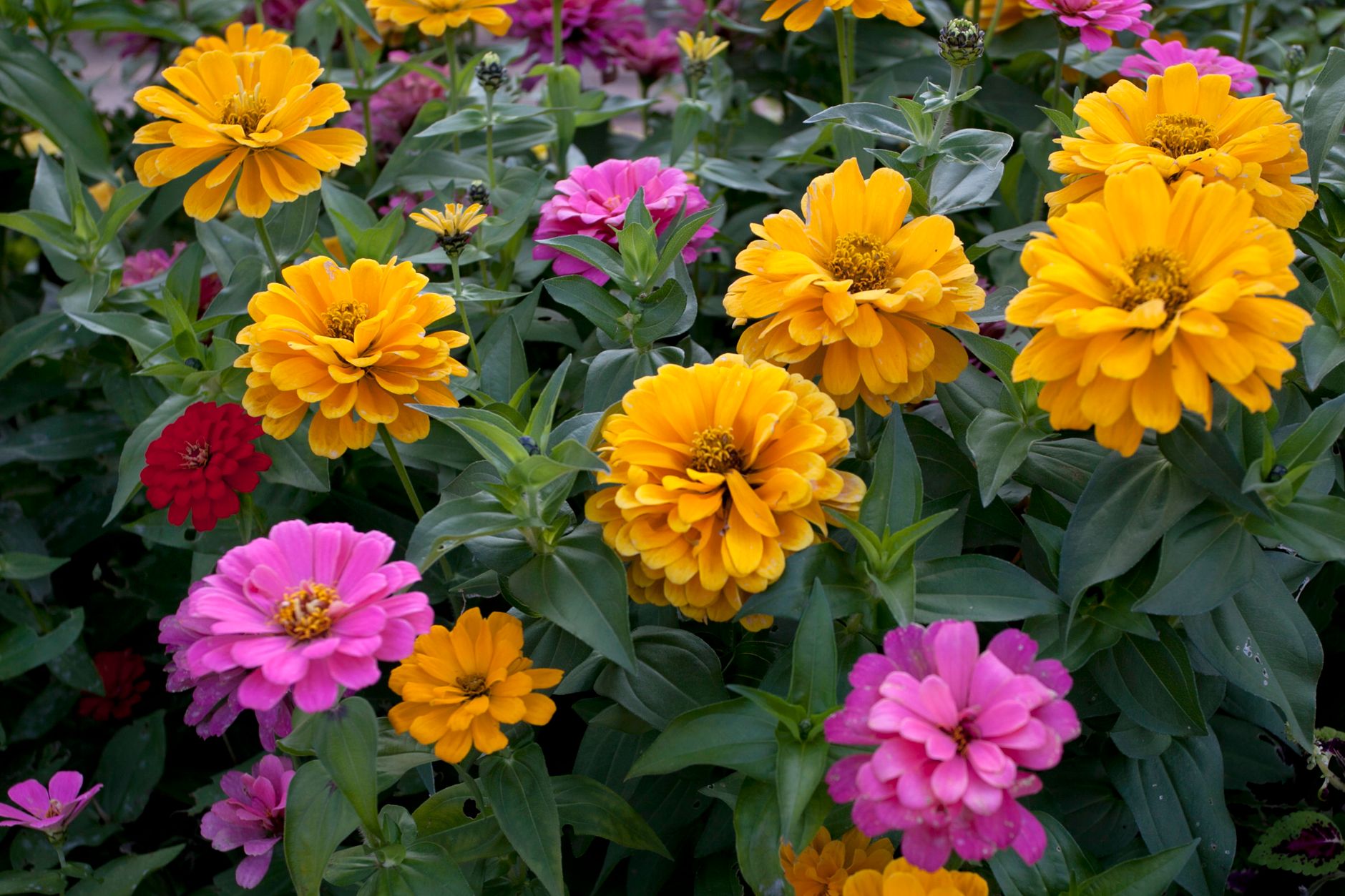
Here is a sentence we never expected to write in a florist’s blog: in January 2016, a zinnia bloomed on the International Space Station, and it nearly did not make it.
It is one of our favorite flower stories, partly because it is true, and partly because it has everything: a mission to Mars, a struggling plant, an astronaut who decided to trust his own eyes, and a bouquet on the dinner table in orbit. We are a florist, not a space agency, so we are going to stick to what NASA and the astronaut himself have said, and then bring it back down to earth, specifically to a kitchen table in San Carlos.
A note: we have no business relationship with NASA or anyone mentioned below. The facts in this post come from NASA’s own account of the experiment and from a first-person essay by astronaut Scott Kelly.
🌱 The Experiment
The experiment used a plant-growth system on the space station called Veggie. Before the zinnias, the crew had grown lettuce in it, and that went rather well. The next step was a flowering plant. Flowers are a bigger ask than leaves: a plant has to grow, form buds, and open them. According to NASA, the zinnia experiment began on November 16, 2015, when astronaut Kjell Lindgren activated Veggie and the small rooting “pillows” that held the zinnia seeds.
Why bother with a flower? In his own account, Kelly says the hope was that if zinnias could manage it, more complex crops, such as tomatoes, peppers, and strawberries, might be possible for future long missions. NASA also described the project as a chance for astronauts to practice what a deep-space mission would require: autonomous gardening.
💧 Why Space Is Hard on a Plant
Gardening in microgravity sounds like it ought to be easy. No weeds, no deer. But in Kelly’s description, roots spread in every direction, soil floats away, and water beads into tight little spheres instead of soaking in, so a plant can die of thirst while sitting in water. Add the electric lights, the closed air, and a crew that has a hundred other things to do, and you can see why a lettuce is one thing and a zinnia is another.
🧫 The Crisis
Here is where the story turns. In December, Kelly was left alone with the plants in his part of the station. They had started to struggle. In his words, leaves curled, water beaded on the edges, and mold crept over the stems. Kelly sent photos to scientists on the ground, who sent back careful instructions. By his account, the communication delay stretched to nearly a week, and the plants kept swinging between too wet and too dry.
So he made a suggestion that Kelly himself describes as a radical change in protocol. NASA quotes him telling the ground team that if we are ever going to Mars and growing food there, the people on the spot would have to decide when the plants need water, the way he would look at his own backyard and think, “maybe I should water the grass today.” He wanted to be the gardener.
The Veggie team agreed. They wrote what they called a “Zinnia Care Guide for the On-Orbit Gardener,” a short, streamlined page of basic guidelines instead of the pages and pages of procedure that most station science follows, and they left the judgment to the astronaut who had the plants in front of him.
It worked. The zinnias began to recover. On January 12, pictures showed the first petals starting to open on a few buds. On January 16, Kelly shared a photograph of a blooming zinnia and wrote: “Yes, there are other life forms in space!”
💐 The Space Bouquet
Kelly describes what happened next in his essay, and it is our favorite part. Once the plants were healthy, he began taking them to the station’s Cupola, the seven-windowed observation module, for some real sunlight. They joined the crew at dinner as a centerpiece. On Valentine’s Day 2016, he harvested the flowers, which were by then red, orange, and yellow. And when his mission ended, he was given some of the dried seeds to plant in his own garden in Houston.
He also describes why it mattered to him. After months in space, he says, one of the things he missed was the natural world: the sun on your face, the wind, the rain, your feet in the grass. Flowers on a table in a metal tube are a small thing, and a very human one.
🧪 What a Florist Takes from It
We have been thinking about this story since we first read it, and here is what we think it can teach anyone who keeps flowers at home, in space or not.
- Look at the flowers, not just the instructions. The best thing that happened to the zinnias was that someone who could see them was allowed to decide. Water that is fine on Monday may not be fine on Thursday. If the stems look limp, check the water, trim them, and adjust. Our pro tips are a starting point, not a rulebook.
- Mold likes stale, damp air. The zinnias on the station struggled in a closed, humid space. On Earth, the same lesson applies to a bouquet crowded in a stuffy corner, or leaves sitting in the vase water, where bacteria and fungus love to grow. Strip the lower leaves and use a clean vase. If you grow zinnias outdoors, space them so air can move between the plants, because they are known to dislike wet leaves and still air.
- Too much water and too little water look alike. A droopy plant might be thirsty or drowning. Feel the soil, or look at the vase, before you reach for the watering can.
- Move your flowers to the sun and the table. Kelly took his plants to the window and to dinner, and so should you. A bouquet that sits where nobody sees it is a bouquet that does not get enjoyed. Keep cut flowers out of direct hot sun and away from the heater, but put them where you will look at them.
- A small flower is a big comfort. We do not need to go to space to understand it. If your week has been mostly screens and meetings, a single stem on the desk does something. Our post about the Monday desk flower covers the case for that.
🌷 Zinnias on the Peninsula
Zinnias are about as down-to-earth as a flower gets, which is part of why we love this story. They come in bright reds, oranges, yellows, pinks, and creams, they are easy to grow from seed, and they make a cheerful cut flower. Late in the season on the Peninsula, you may still find them alongside dahlias and late sunflowers at the market stalls. Our post about early-fall bouquets shows what is in season now, and our farmers market guide has a sense of what to look for at the stalls. For a close cousin, see our guide to sunflowers, which turn to follow the sun in a way that astronauts would appreciate.
If you would like to try growing zinnias next spring, our guide to the best nurseries and garden centers near San Carlos is the place to start. And if you have ever lost a houseplant, take heart: our post on why your last houseplant died is a kind read. Even an astronaut nearly lost his zinnias.
🌌 A Peninsula Footnote
San Carlos sits in the middle of the Peninsula, and a short drive down the road is NASA’s Ames Research Center, in Mountain View. We are not going to claim a connection to the zinnia experiment, because it was a space station project and we do not know Ames’ role in it. But we like living in a region where the same few miles hold both a farmers market and a space agency, and where someone is always working on the next hard thing.
🎁 A Bouquet for the Person Working on the Next Hard Thing
Everyone on the Peninsula knows someone who is building something, whether it is a product, a company, a lab experiment, or a very ambitious garden. A bunch of bright, sturdy flowers, with a card that says something like “Yes, there are other life forms out there,” is a cheerful way to say you are thinking of them. We deliver to San Carlos, Redwood City, Menlo Park, Palo Alto, San Mateo, and across the Peninsula. Our thank-you flowers page and our guide to thank-you flowers have more ideas.
🧡 The Short Version
A zinnia bloomed in orbit because someone watched it closely, trusted his judgment, and kept it in sight of the window. That is good advice for a houseplant, a garden, and a bouquet. Fresh water, clean vase, good air, and a spot where you will see it. The rest is looking.